What Domain Status Codes Mean for DNS, Uptime, and Hosting Reliability

February 27, 2026 by Staff Writer
What Domain Status Codes Mean for DNS, Uptime, and Hosting Reliability
Domain status codes are among the most underappreciated signals in infrastructure management. For hosting providers, DevOps teams, and IT managers responsible for uptime and service continuity, a domain's WHOIS status is not administrative background noise — it is operational data.

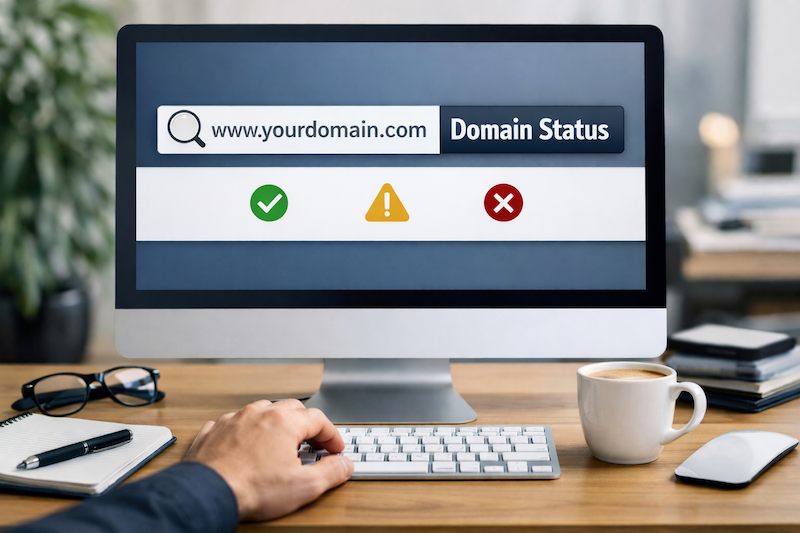
Running a domain status check on any production domain reveals a set of EPP (Extensible Provisioning Protocol) status codes that directly affect whether that domain can be modified, transferred, or, critically, whether it remains resolvable at all.

Understanding what those codes mean, and building monitoring workflows around them, is a meaningful component of infrastructure risk management. This article covers the technical mechanics of domain status codes, how they interact with DNS and hosting reliability, and how teams managing multiple client domains or production environments can integrate status monitoring into their broader operational posture.

What Domain Status Codes Actually Are
Domain status codes are standardized flags assigned by registries and registrars to communicate the operational and administrative state of a registered domain. They are defined under ICANN's EPP framework and appear in WHOIS records for any domain under most generic and country-code TLDs.

Each status code has a specific, bounded meaning. They are not vague or interpretive — a domain marked clientTransferProhibited cannot be transferred away from its current registrar until that lock is lifted. A domain marked pendingDelete is in a countdown to permanent removal from the registry. These are hard system states with direct operational consequences.
There are two primary categories of status codes:

     1. client-side codes, which are set by the registrar,
     2. server-side codes, which are set by the registry.

Both types affect what operations can be performed on a domain and, in some cases, whether the domain continues to function in DNS.

The EPP Status Code Taxonomy

The Extensible Provisioning Protocol is the standardized XML-based protocol used by domain registries and registrars to communicate domain lifecycle operations — including creation, renewal, transfer, update, and deletion. EPP is the technical foundation on which all status codes are built, and understanding it clarifies why these codes behave as hard system states rather than advisory flags.

Client-Side Codes

Client-side codes are prefixed with client and are set at the registrar level. They represent controls the registrar or account holder applies to a domain's lifecycle.
  • clientTransferProhibited is the most common status code for active domains. It prevents the domain from being transferred to another registrar without explicit action to remove the lock. This is a standard protective measure and should be active on virtually all production domains.
  • clientUpdateProhibited prevents modifications to the domain's registration data — including nameserver changes. For infrastructure teams, this is significant: if this status is active and you need to update DNS delegation, you must first remove the lock at the registrar level. Failure to account for this during a migration can result in hours of avoidable delay.
  • clientDeleteProhibited prevents the domain from being deleted. This is appropriate for business-critical domains and should be enabled on any domain tied to production infrastructure.
  • clientHold is a status that suspends DNS resolution for the domain. A domain with clientHold active will not resolve — period. This status is typically applied by a registrar due to a compliance issue, payment failure, or legal hold. From a hosting perspective, a domain entering clientHold is functionally equivalent to the site going offline, regardless of how healthy the underlying server infrastructure is. 


Server-Side Codes

Server-side codes are set by the registry and carry more authority. They cannot be overridden by the registrar without registry-level action.
  • serverTransferProhibited and serverUpdateProhibited function similarly to their client-side equivalents but are enforced at the registry level. These are often applied to domains that are in legal dispute, under ICANN dispute resolution proceedings, or flagged for compliance reasons.
  • serverHold is the registry-level equivalent of clientHold. A domain with serverHold active has its DNS suspended by the registry itself. This is typically seen in cases of UDRP disputes, regulatory action, or policy violations. Resolution requires direct engagement with the registry, which can take significantly longer than resolving a registrar-level issue.
  • pendingTransfer indicates a transfer is in progress. During this state, nameserver changes may be restricted, and the domain's DNS configuration could be in transition. For teams migrating infrastructure, initiating a transfer and a DNS cutover simultaneously can create a window of instability.
  • pendingDelete is the most critical status code from an uptime risk perspective. A domain in pendingDelete has already been through the expiration and redemption period and is queued for permanent deletion from the registry. Once deleted, the domain can be registered by anyone. For production domains, this is a catastrophic state.

How Domain Status Interacts With DNS Infrastructure

The relationship between domain status and DNS behavior is direct. DNS resolution for a domain depends on that domain being active and having valid nameserver delegations at the registry.

Status codes that affect domain operability — clientHold, serverHold, pendingDelete — disable DNS at the registry level, which means no amount of correctly configured authoritative DNS records will save you.

This is an important architectural point: hosting infrastructure and DNS infrastructure can both be perfectly functional while a domain-level status issue renders the entire stack unreachable. The failure mode originates above DNS in the hierarchy, at the registry itself.

Nameserver Delegation and Status Locks

When clientUpdateProhibited or serverUpdateProhibited is active, nameserver records on the domain cannot be changed. For teams planning a migration to new hosting infrastructure, this creates a sequencing requirement: status locks must be evaluated and selectively removed before any DNS cutover can occur.
This is a detail that gets missed in migration planning with enough regularity that it warrants a formal checklist item. Many migration post-mortems include a variation of "DNS didn't propagate because we couldn't update nameservers" — and in a number of those cases, the root cause is an update lock that nobody checked during planning.


TTL Management and Status Windows

DNS TTL (Time to Live) values control how long resolvers cache DNS records. During any period where domain status changes are expected — renewals, transfers, migrations — TTL management becomes particularly important.

If you are expecting to make nameserver changes on a domain, reducing TTLs in advance (ideally 24–48 hours before the change window) ensures that once the change is made, propagation completes quickly. This is standard practice, but it depends on being able to make the change at all. If a status lock is present, you may lower TTLs only to discover you cannot proceed with the nameserver update on schedule.


Domain Expiration as an Infrastructure Risk Vector

Domain expiration is one of the most preventable causes of infrastructure outage, yet it remains a recurring failure pattern across organizations of all sizes. The lifecycle of an expiring domain follows a predictable path, and each stage has different implications for recovery.


The Expiration Lifecycle

When a domain reaches its expiration date without renewal, it does not immediately become unavailable. Most registrars provide a grace period — typically 0–45 days depending on the TLD — during which the domain can be renewed at standard pricing. During this period, DNS may continue to function or may be suspended depending on the registrar's policy.

After the grace period, the domain typically enters a redemption period — a 30-day window during which it can still be recovered but at a significantly elevated redemption fee. The domain's DNS is generally suspended during redemption, meaning the website and any associated services (email, API endpoints, authentication callbacks) go offline.

After the redemption period, the domain enters pendingDelete status and is queued for release. Once released, it enters the open market and can be registered by any party — including bad actors specifically watching for valuable domains to lapse.


Second-Order Infrastructure Failures

The failure cascade from domain expiration extends beyond web unavailability. Consider the dependencies that route through a domain:
  • Email delivery routes through MX records on the domain. If the domain lapses, inbound email fails. Depending on the MTA configuration, senders may receive bounce errors or mail may queue and eventually be dropped.
  • SSL/TLS certificates tied to the domain will fail validation if the domain is unreachable, generating browser security warnings for any users who encounter cached or stale routing to the endpoint.
  • API integrations, webhook endpoints, OAuth redirect URIs, CDN configurations, and monitoring agents may all reference the domain. A domain-level outage can cascade into application failures that appear unrelated to the root cause — particularly in microservices architectures where individual service URLs might not be immediately recognizable as belonging to the same base domain.


Monitoring Strategies for Domain Status at Scale

For hosting providers and agencies managing dozens or hundreds of client domains, ad-hoc manual checks are not a viable monitoring strategy. Domain status monitoring needs to be integrated into operational tooling with the same rigor applied to server uptime and certificate expiration.


Automated WHOIS Polling

WHOIS data is queryable programmatically. Building or deploying tooling that polls WHOIS records for a domain inventory on a scheduled basis — daily for standard domains, more frequently for high-criticality assets — gives teams early warning of status changes before they become outages.
The key data points to extract and alert on include: expiration date (alert threshold at 60, 30, and 7 days), nameserver delegation (alert on unexpected changes), and EPP status codes (alert on any transition to clientHold, serverHold, pendingDelete, or pendingTransfer).


Integrating Domain Status Into Incident Management

Domain status changes should be treated as potential P1 signals, not informational notifications. A domain entering pendingDelete or clientHold affecting a production asset should trigger the same escalation path as a server going offline — because from the user's perspective, the outcome is identical.
Integrating domain monitoring into existing incident management systems (PagerDuty, Opsgenie, or equivalent) ensures that domain-level events are not siloed in a registrar dashboard that nobody checks until something breaks.


Multi-Registrar Environments

Organizations with domains spread across multiple registrars face an aggregation challenge. Each registrar has its own dashboard, notification settings, and renewal workflow. Centralizing the monitoring layer — even if the registrar relationships remain distributed — is an important operational control.
There are domain management platforms designed for portfolio-level oversight that abstract the multi-registrar complexity. Evaluating these tools against operational requirements is worthwhile for any team managing more than a few dozen domains.


Security Implications of Domain Status Monitoring

Domain security and infrastructure security are tightly coupled. Domain hijacking, DNS hijacking, and domain expiration squatting are all attack vectors with direct infrastructure impact.


Domain Hijacking via Status Manipulation

Attackers who gain access to a registrar account can remove protective locks (clientTransferProhibited, clientUpdateProhibited) and initiate unauthorized transfers or nameserver changes. The window between lock removal and detection is the attack surface.
Monitoring for unexpected status code changes — particularly the removal of transfer and update locks on production domains — provides early detection capability for this attack pattern. A domain that had three protective codes and now shows only ok has had locks removed, which warrants immediate investigation.


DNS Hijacking and Nameserver Monitoring

Even without a full domain transfer, an attacker with registrar account access can modify nameserver delegation. This redirects all DNS queries for the domain to attacker-controlled infrastructure, enabling phishing, credential harvesting, and traffic interception at scale.

Nameserver monitoring — alerting on any change to the NS records for a domain — is a straightforward control with high signal value. Legitimate nameserver changes are planned events that should be reflected in change management records. Unplanned nameserver changes are incidents.


DNSSEC as a Mitigation Layer

DNSSEC (DNS Security Extensions) provides cryptographic validation of DNS responses, protecting against certain classes of DNS spoofing and cache poisoning attacks. Enabling DNSSEC on production domains adds a layer of integrity verification that complements registrar-level security controls.

DNSSEC is not universally deployed and has its own operational complexity — key rotation, DS record management at the registry, and compatibility considerations. For high-value production domains where DNS integrity is critical, the operational overhead is generally justified.


Operational Checklist for Domain-Aware Infrastructure Management

The following represents a minimum viable set of controls for teams managing production domains as part of their infrastructure posture.

Registration and renewal controls: All production domains should have auto-renewal enabled. Expiration dates should be inventoried and monitored with alerting at 60, 30, and 7 days. Domains with significant business value should be registered for multi-year terms where possible.

Status lock configuration: All production domains should have clientTransferProhibited and clientDeleteProhibited active at minimum. clientUpdateProhibited should be active for stable domains and removed only during planned change windows.

Access controls: Registrar accounts should use strong, unique credentials with multi-factor authentication enabled. Access should be limited to personnel with operational need. Account recovery options (email addresses, phone numbers) should be regularly verified and updated.

DNS delegation monitoring: Nameserver records should be monitored for unexpected changes. Any nameserver modification should be treated as a potential security incident until corroborated by change management records.

Certificate alignment: SSL/TLS certificate expiration monitoring should account for domain expiration as an upstream dependency. A certificate cannot be renewed for a domain that has lapsed. Certificate monitoring tools should cross-reference domain expiration dates.

Incident classification: Domain status changes affecting production assets — particularly clientHold, serverHold, or pendingDelete — should be classified as incidents and handled through the organization's standard incident response process.

Conclusion
Domain status is operational infrastructure data, not registrar paperwork. The EPP codes visible in a WHOIS record encode the current state of a domain's administrative and operational lifecycle, and changes to those codes have direct, sometimes immediate consequences for DNS resolution, hosting reliability, and application availability.

For hosting providers managing client infrastructure, DevOps teams running production environments, and IT managers responsible for organizational uptime, domain status monitoring belongs in the same operational category as server health checks and certificate expiration alerts. The failure modes are just as real, the blast radius is comparable, and the preventive controls are straightforward to implement.

The organizations that avoid domain-related outages are not the ones that get lucky — they are the ones that treat domain management as an infrastructure discipline and build the monitoring, alerting, and access controls to match.

Article Rating

Rate this article:

Article Rating

Rate:

  • 1
  • 2
  • 3
  • 4
  • 5

Top 3 Hosts From Our Search

1Serverly Server Hosting
2Packetra
3Santo Host